How to Choose a Tech Recruiting Agency That Hires Well
Most advice about choosing a tech recruiting agency starts with the wrong question: contingency, retained search, or RPO? Those labels matter, but they don't tell a hiring leader whether the agency can distinguish a production Kubernetes operator from someone who copied “Kubernetes” into a résumé. They also don't reveal whether candidates receive timely updates, whether interview data is calibrated, or whether the agency sends the same person to three competing clients.
The better question is harder and more useful: Can this agency reduce hiring risk, and can it prove that through its process? The global IT staffing market was estimated at USD 123.30 billion in 2025, with a projection of USD 127.75 billion in 2026, according to Mordor Intelligence's IT staffing market analysis (opens new window). Buyers have plenty of choice. They also have plenty of résumé resellers to filter out.
# What a Tech Recruiting Agency Actually Does
A real tech recruiting agency is an external hiring function, not a forwarding service. It maps the talent market, calibrates the role with the hiring manager, finds people who aren't actively applying, tests relevant capabilities, manages the interview process, supports references and offer negotiation, and stays involved after the start date. A résumé vendor skips most of that and measures success by how many profiles enter an inbox.
Sales calls blur this distinction. Almost every agency claims technical specialization, a deep network, and rapid delivery. Those claims mean little without evidence of how recruiters evaluate the work. A recruiter who can repeat a job description is not necessarily capable of assessing distributed systems, incident ownership, cloud architecture, secure development, or the commercial consequences of a technical decision.
Agencies earn their fee by reducing hiring risk, not by sending more names.
That principle changes the buyer's standard. A strong partner begins with market mapping, identifying where qualified candidates work, which titles they use, what compensation structures attract them, and whether the search requires local, remote, contract, or international sourcing. The intake meeting then separates genuine requirements from a manager's wish list. “Experience with AWS” is weak intake language. “Owned production workloads on AWS, designed service boundaries, and participated in incident response” gives a recruiter something observable to test.
# The operating work behind a credible search
The agency's responsibilities should include:
- Intake calibration: Document must-haves, trainable capabilities, disqualifiers, reporting lines, interview stages, and decision authority.
- Sourcing and market mapping: Build a targeted pool instead of scraping job-board applicants and calling it a search.
- Structured screening: Explore what candidates built, why they chose an approach, how they operated it, and what changed for the business.
- Interview coordination: Prepare candidates, manage scheduling across time zones, collect feedback, and prevent stalled decisions.
- References and closing: Verify employment context, address objections, negotiate the offer, and protect the candidate relationship.
- Post-placement follow-through: Check whether the hire joined, settled into the role, and remains aligned with expectations.
This work sits alongside, rather than inside, a company's own recruiting stack. A hiring team may use LinkedIn (opens new window) for research, an ATS for workflow, and an agency for specialist judgment. The agency should improve the quality of those decisions, not create another disconnected pipeline.
The case for specialization is structural. Deloitte reported technology-talent unemployment at 1.8% in March 2023, compared with 3.5% national unemployment, while demand for software engineers was 1.6 times higher than available supply. The same Deloitte technology workforce analysis (opens new window) found that 69% of global employers struggled to find workers combining technical and human capabilities. Scarcity makes poor screening expensive.
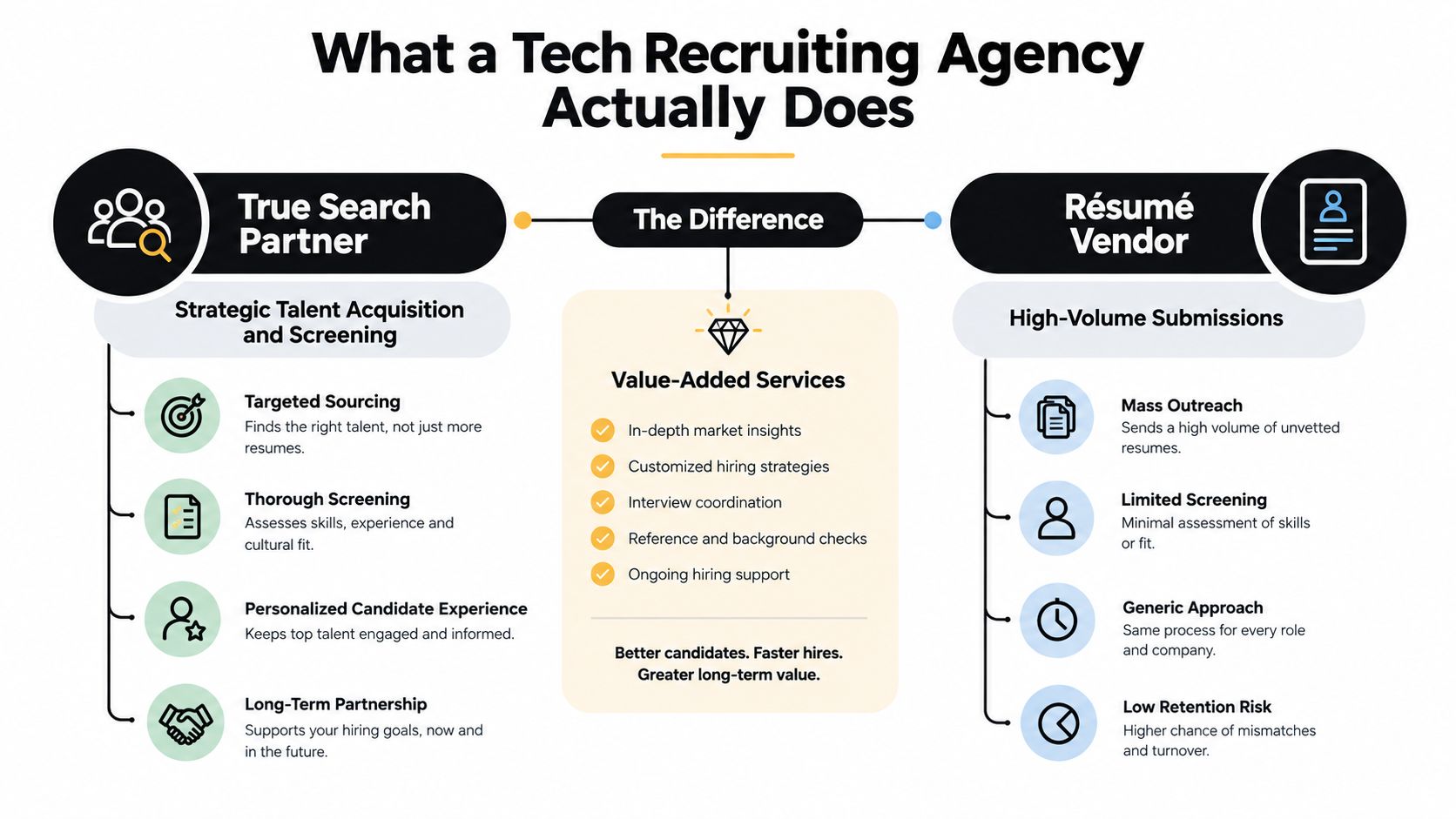
A buyer should therefore assess six things before discussing fees: service-model fit, vertical specialization, pricing transparency, funnel metrics, onboarding discipline, and red-flag awareness. The agency that wins the search should be the one that can show its work at every stage.
# Service Models and When Each One Makes Sense
The four common models aren't interchangeable. Each allocates time, exclusivity, payment risk, and ownership differently. Choosing the cheapest-looking option often produces the most expensive outcome when the role is scarce or the hiring manager lacks capacity to evaluate candidates.
| Model | Typical Fee | Best For | Risk on Agency |
|---|---|---|---|
| Contingency | Success fee paid on placement | Mid-level roles with a broad talent pool | High delivery risk, limited exclusivity |
| Retained search | Upfront or staged fee for a dedicated search | Senior, niche, confidential, or executive roles | Lower delivery risk because work is funded |
| Contract staffing | Markup over the contractor's hourly rate | Projects, rotations, temporary capacity, and flexible headcount | Agency carries payroll and employment administration |
| RPO | Monthly or per-hire commercial model | Sustained hiring volume and embedded recruiting operations | Agency owns more process and delivery responsibility |
Contingency works when several agencies can access a reasonably active market and the buyer can respond quickly. It isn't automatically bad. It becomes bad when a hiring team uses it for a confidential executive search, gives the agency a vague brief, and then complains that the agency sends generic candidates. The model rewards speed and access, not necessarily deep market research.
Retained search earns its fee when the candidate pool is passive, the role is sensitive, or the consequences of a weak appointment are severe. A dedicated researcher can map a narrow market, build trust with prospects, and protect confidentiality more effectively than multiple firms competing to submit first. The buyer should expect defined milestones, named consultants, and a search strategy rather than a promise to “see what comes in.”
Contract staffing suits a company that needs capability without committing immediately to a permanent headcount. It can support a project, an SRE rotation, a migration, or a temporary gap while a permanent search continues. The contract must spell out supervision, replacement, conversion, intellectual property, confidentiality, and termination terms.
RPO makes sense when hiring is recurring enough to justify an embedded operating layer. The agency may manage ATS workflows, employer-brand messaging, sourcing, reporting, recruiter capacity, and hiring-manager training. It isn't a dressed-up contingency arrangement. If the agency won't take responsibility for process quality, an RPO premium isn't justified.
Decision rule: If the buyer can't explain why one model fits the role better than the others, the engagement is probably defaulting to contingency.
A practical selection sequence is simple. First, classify the role by scarcity and seniority. Next, estimate the internal team's screening and coordination capacity. Then decide whether the business needs a person, flexible capacity, or a repeatable hiring operation. Fee structure comes after those decisions, not before them.
# Specializations That Matter More Than Headlines
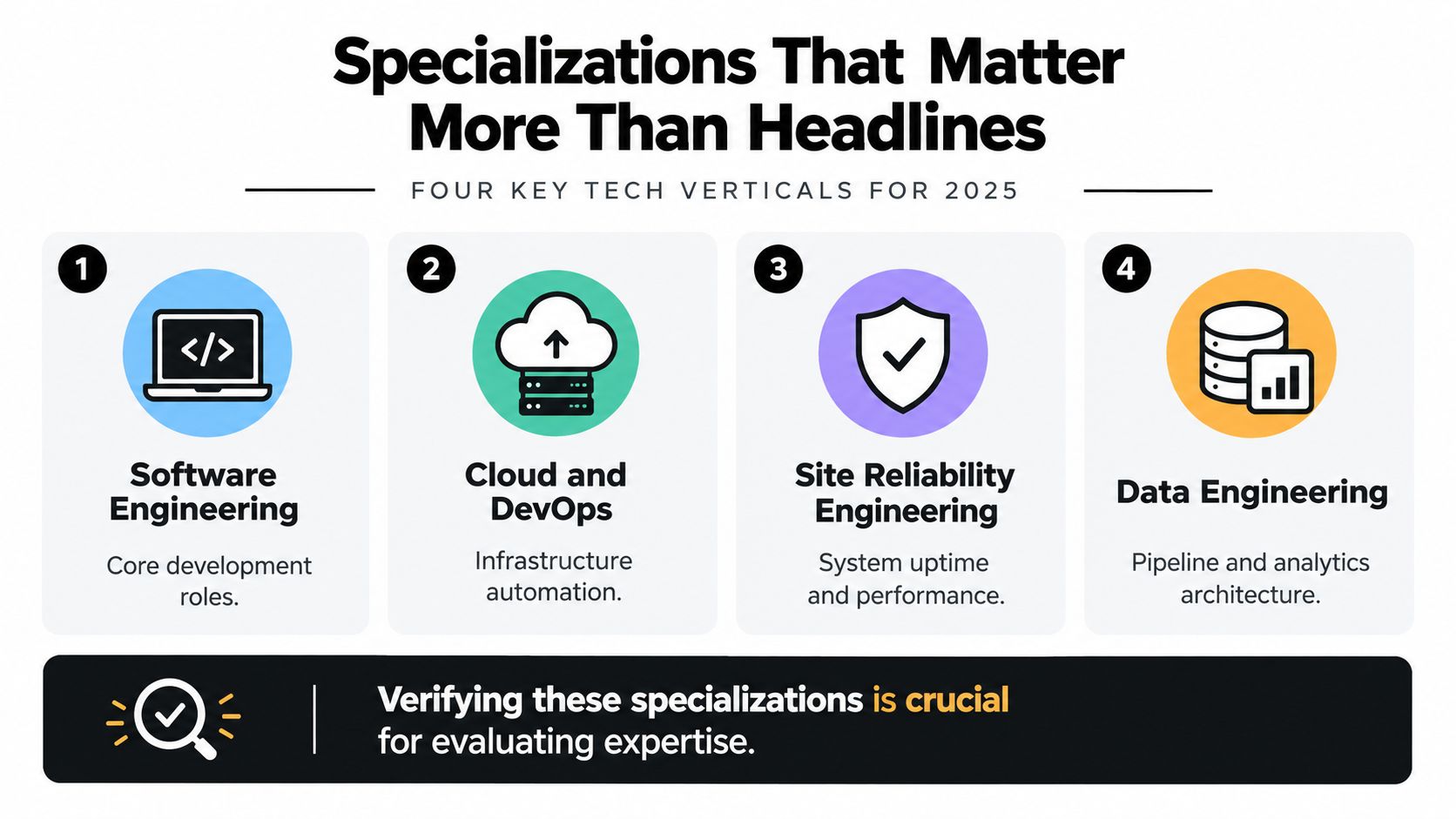
An agency's website can list every modern technology and still lack meaningful expertise. Buyers should test specialization through evidence of work, not through logos, job-title libraries, or polished language about innovation.
The relevant areas include software engineering, cloud and DevOps, site reliability engineering, data engineering, machine learning, cybersecurity, and AI integration. These domains overlap, but they don't use the same screening signals. A recruiter who understands frontend hiring may still miss the difference between a platform engineer who operated Kubernetes and one who designed cluster architecture, set policy, or handled failure under load.
# Three questions that expose shallow expertise
Ask which production systems the agency's recent placements operated. A credible answer should describe the environment, scale or complexity qualitatively, the candidate's ownership, and the type of business problem involved. “They worked with AWS” is not enough. The useful answer explains whether the person built infrastructure, migrated workloads, improved reliability, secured access, or merely consumed an existing service.
Ask which interview rubric the agency uses for senior candidates. Seniority should bring questions about trade-offs, architecture, operational judgment, mentoring, incident response, and business context. A recruiter who relies only on language keywords will confuse tool familiarity with engineering depth.
Then ask how the agency separates a candidate who has used Kubernetes from one who designed it. The same test works for Terraform, Snowflake, Kafka, Datadog, Salesforce, or a security platform. The answer should involve scope, decisions, ownership, failure modes, and outcomes, not a list of certifications.
Recent hiring evidence makes this validation urgent. An analysis from Robert Half on in-demand technology roles (opens new window) reported that AI, machine-learning, and data-science postings rose 163% year over year in 2025 to 49,200 postings, while security postings rose 124% to 66,800 postings. Those figures indicate pressure across several disciplines, not permission to recruit anyone with “AI” in a profile.
A useful final filter is conversational. A specialist recruiter should be able to name three obscure tools, one niche certification, and one community of practice relevant to the role without searching for the answer. The buyer can also request anonymized scorecards, sample screening questions, and an explanation of how the agency validates portfolios or work samples. Candidate research may begin through GitHub (opens new window), but the agency still has to determine what the contribution proves.
# How TekRecruiter Can Help
TekRecruiter is a staffing and recruiting agency focused on technology and engineering talent for SaaS companies, startups, and enterprises. Its stated coverage includes software engineering, product, go-to-market technical roles, leadership, cloud platforms, cybersecurity, data, AI, and specialized engineering disciplines. That breadth is useful for companies whose hiring plan crosses technical and commercial functions, but buyers should still test the recruiter assigned to the specific search rather than rely on the firm's category list.
The firm's approach is built around a technical origin story. Founder Ron Smith is described as a computer science graduate and former founding software engineer who moved into technical recruiting after building data systems at a startup. That background matters because it suggests the agency was created to address a common failure in staffing, recruiters selling technical expertise without understanding the work.

TekRecruiter describes its operating system as AI-native, with technology supporting sourcing, pipeline management, screening, and matching while human recruiters conduct the conversations and make judgment calls. Its candidate process emphasizes the ability to explain how work was built, why decisions were made, and what the work did for the business. That is a stronger screening philosophy than keyword matching, provided the buyer can see how it is applied to the open role.
The agency reports 167 tech and engineering placements in 2026 so far and an 82% interview rate for submitted candidates, as stated in its supplied company information. Those are agency-reported figures, so a buyer should ask how “submitted,” “interviewed,” and “placement” are defined, and whether the numbers vary by role family.
TekRecruiter offers direct hire with a 90-day placement guarantee, contract-to-hire, IT staff augmentation, nearshore recruiting, executive search, and supplier search. Its nearshore offering covers English-speaking engineers in Latin America, including Brazil, while its supplier search helps companies identify MSPs, IT outsourcing firms, software development companies, AI engineering providers, and fractional technology leaders. Supplier engagements are described as direct contracts between client and supplier, with the supplier paying TekRecruiter a stated 10% finder's fee.
For a buyer comparing options, tech recruiting agency (opens new window) is a useful starting point for reviewing the firm's service coverage and specialization. TekRecruiter is the right fit when a company needs technical judgment, flexible engagement models, and access to both hiring and supplier markets. It is not a substitute for a calibrated brief or a buyer-side interview process. The client still needs to define ownership, evidence standards, feedback timing, and the replacement mechanism in writing.
# Pricing Mechanics and the SLAs Worth Negotiating
Price tells only part of the story. A low fee attached to weak screening can cost more than a higher fee attached to a reliable shortlist, because engineering leaders spend scarce time interviewing candidates who never had a realistic chance of succeeding.
For permanent roles, contingency fees commonly sit between 18% and 25% of first-year base salary, while retained search often ranges from 25% to 33%, usually paid in installments, according to the provided market guidance. Contract staffing generally uses a markup over the contractor's hourly rate, commonly 30% to 50%, to cover payroll, benefits, compliance, and agency overhead. RPO pricing is usually monthly or per hire, with volume economics negotiated around the operating scope.

The buyer's bargaining power rests in the contract details. A commercial proposal should define:
- Replacement coverage: The agency replaces a hire who leaves under specified conditions, with a clearly stated window.
- Refund triggers: The agreement explains what happens if a candidate declines, rescinds, or fails to start.
- Candidate ownership: The parties establish who owns a candidate when several sources contact the person or a contractor converts.
- Reporting cadence: Weekly reporting should show stage movement, source, rejection reason, aging, and next action.
- Service continuity: The named recruiter, backup coverage, escalation route, and communication standard belong in the statement of work.
A worked example exposes the difference between price and value. Suppose an agency submits six candidates, four reach technical interviews, two reach a final loop, and one accepts. That sounds efficient until the hiring manager explains that the first three submissions lacked the required production experience and that the candidate withdrew after repeated scheduling delays. A different agency may submit fewer names but produce a higher proportion of relevant screens, faster feedback loops, and a better acceptance outcome.
The hard rule is straightforward: never sign a permanent technology hiring agreement with a replacement window shorter than 60 days. Early attrition is a common failure mode, and a guarantee that expires before the hire has properly entered the role protects the agency more than the buyer.
# How to Read the Hiring Funnel Behind the Pitch
An agency can claim a large network and rapid delivery while hiding a broken funnel. The buyer should ask for stage-level evidence instead of accepting application counts, résumé volume, or “active candidates” as proof of quality.
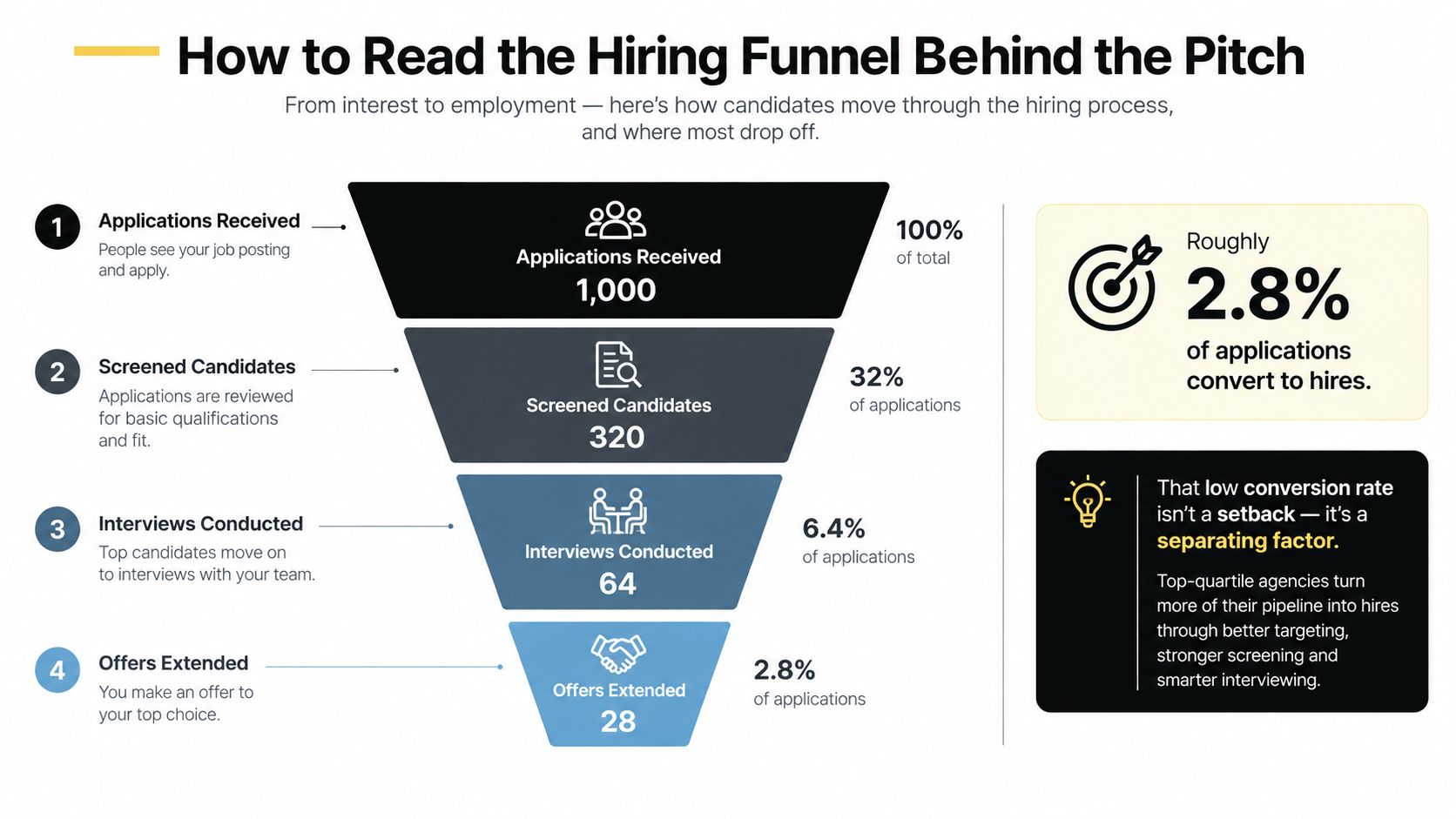
Available benchmark data puts technical hiring conversion at approximately 2.8% of applications into hires, with about 120 applications and 8 interviews per hire, a hiring cycle of roughly 42 days, and offer acceptance near 72%, according to EasyHire's recruiting funnel analytics benchmark (opens new window). These are directional benchmarks, not a universal target. Their value is diagnostic.
# What each stage tells the buyer
Application to screen reflects sourcing relevance. A weak conversion rate often means the agency misunderstood the brief, targeted the wrong seniority, or relied on broad keyword searches.
Screen to technical interview tests intake calibration. If many screened candidates fail once an engineer evaluates them, the recruiter may be asking the wrong questions or presenting candidates whose experience only resembles the requirement.
Technical interview to offer reveals rubric discipline and hiring-manager alignment. A low rate can indicate unrealistic expectations, inconsistent interviewers, or inadequate pre-screening.
Offer to acceptance shows closing quality and employer-brand health. Declines may point to compensation, unclear role scope, slow approvals, poor communication, or competing offers.
Consider a sample engineering search with 140 applications, 18 screens, 9 technical interviews, 3 onsite loops, and 1 accepted offer after 78 days. The example is intentionally separate from benchmark data. The two obvious regressions are the long cycle and the low application-to-hire conversion, approximately 0.7%, while the nine technical interviews for one hire also signal heavy evaluation load. The agency should explain whether the issue began in sourcing, technical calibration, scheduling, or offer management.
A buyer should request the last five placements mapped through the same stages. The agency must explain every material variance from its own historical range, not just defend a single success story. The reporting should include role family, seniority, geography, sourcing channel, stage age, rejection reason, and accepted-offer status.
The agency's reports can sit beside internal research and sourcing tools such as Indeed (opens new window), but the principle remains the same: the hiring leader needs traceable movement, not a dashboard designed to make poor performance look busy.
# Onboarding the Agency So the First 30 Days Count
A signed agreement doesn't create a working search. Most agency failures begin during the first week, when the buyer treats onboarding as a kickoff call and expects the recruiter to infer the rest.
The first working session should be a serious intake calibration. The hiring manager, recruiter, technical interviewer, and decision owner should agree on must-haves, trainable skills, disqualifiers, compensation boundaries, work location, interview stages, and the evidence required for submission. The agency should leave with a written scorecard, not a collection of impressions.
# The four operating pillars
Intake calibration turns a vague job description into observable signals. The brief should distinguish “has used” from “has owned,” and it should identify which requirements can be learned after hiring.
Employer-brand assets give candidates a reason to engage. A concise team one-pager, a technology-stack diagram, a description of technical debt, and a short team video are more useful than generic culture language.
Technical rubric prevents résumé forwarding. Each submission should arrive with an evidence summary tied to the role's criteria, including the candidate's environment, responsibility, trade-offs, and relevant gaps.
Reporting setup creates accountability from the start. A shared dashboard should track submissions, source, stage, rejection reason, aging, candidate experience signals, and relevant diversity, equity, and inclusion measures.
The buyer should prepare five items before the contract starts:
- Hiring-manager access: A named decision-maker must be available for calibration and feedback.
- Compensation documentation: The approved band and flexibility rules should be written down.
- Technical-debt context: Candidates need an honest description of the systems they will inherit.
- Interview capacity: The panel should reserve time before the first candidate enters the process.
- Candidate-experience statement: Communication expectations, scheduling flexibility, accessibility, and feedback timing should be explicit.
A practical 14-day ramp includes the intake session, asset delivery, rubric review, market feedback, first calibrated submissions, and a correction meeting. If the agency cannot produce useful market signal during that ramp, the buyer should revise the role or challenge the firm's sourcing approach before more candidates enter the funnel.
# Red Flags, Misconceptions, and What to Do Instead
A promise to fill a technical role inside two weeks is not a strategy. It may be realistic for an unusually liquid market, but an agency that guarantees the outcome before understanding the role is selling confidence rather than search quality.
Several warning signs deserve immediate pushback:
- Guaranteed placement timelines: Ask what assumptions support the promise, what happens when the market disagrees, and whether the agency will document its search activity.
- No funnel reporting: Refusal to show stage conversion, rejection reasons, and aging means the buyer can't distinguish scarcity from poor execution.
- Exclusivity without retained economics: A buyer shouldn't surrender access to other providers unless the agency commits dedicated resources and defined deliverables.
- Frequent recruiter replacement: A new recruiter every quarter destroys calibration and makes accountability difficult.
- Undisclosed subcontracting: The agency must disclose who sources, screens, contacts, and stores candidate information.
The bigger-bench misconception also needs correction. More recruiters can mean more outreach, but it can just as easily mean weaker screening and duplicated contact. References aren't a formality either. They can reveal ownership, communication, reliability, and retention concerns that interviews miss. Contractor conversion isn't automatic; ownership, fees, notice periods, and restrictions depend on the agreement signed at the beginning.
Candidate experience belongs in the audit. Global research reported that only 19% of employers rated their hiring process as excellent, with IT reaching 25%, while 26% specifically identified candidate experience as a challenge. The ManpowerGroup candidate journey research (opens new window) also identified recruiter communication, an easy application process, and flexible interview scheduling as leading contributors to a positive experience, each selected by 51% of respondents.
A larger talent pool can worsen outcomes when the agency increases volume without improving screening transparency and communication.
The final scorecard should rank each provider on five dimensions: vertical expertise, funnel transparency, candidate experience, replacement policy, and commercial clarity. Fees matter, but they belong after those checks. A cheap agency that damages the employer brand, consumes engineering time, and sends weak candidates isn't cheap.
The right next step is an agency audit, not another vendor comparison. Ask each finalist for a role-specific intake plan, sample technical scorecard, stage-level funnel report, candidate-communication standards, named delivery team, replacement terms, and a clear explanation of who does the work. For teams building or maintaining Laravel authentication integrations alongside hiring operations, Socialite Providers (opens new window) offers documented OAuth and OpenID Connect packages that reduce duplicated integration work, so technical capacity can stay focused on the product rather than avoidable identity plumbing.