Medical Virtual Assistant Services: 2026 Practice Guide
A clinician waits for a progress note while the front desk handles prior-authorization calls, reschedules a no-show, and tries to answer a patient asking whether a referral was received. The problem isn't that the team is busy. It's that routine coordination, sensitive information, and clinical decisions are arriving through the same doorway.
Medical virtual assistant services can relieve that pressure, but only when a practice defines the boundary correctly. A remote assistant may schedule a visit, collect intake information, follow up on an authorization, or prepare documentation for review. The assistant shouldn't diagnose, prescribe, independently interpret red-flag symptoms, or make an unreviewed clinical disposition.
The safest way to evaluate these services is through decision rules. A task is suitable when its inputs, authority, escalation path, and audit trail are clear. A vendor is suitable when its staffing model, security controls, and accountability match the risk of the work.
# What Medical Virtual Assistant Services Actually Do
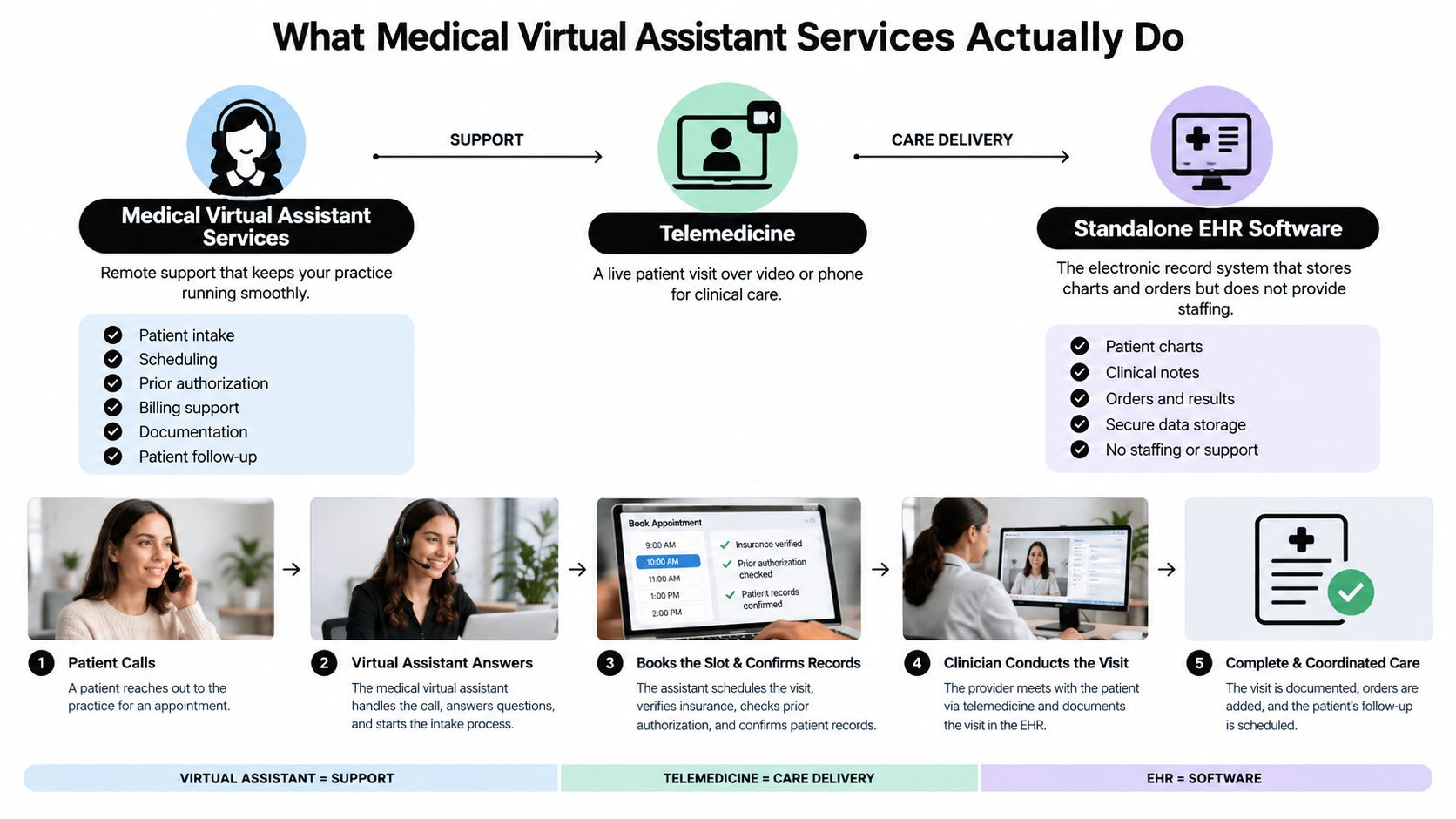
A medical virtual assistant service provides remote human support, software-based assistance, or a combination of both for healthcare operations. The work usually sits next to clinical care rather than replacing it. A remote human may answer calls, schedule appointments, verify information, or enter approved data into an EHR. An AI assistant may collect structured symptoms or draft a summary, but a qualified professional must control tasks that require clinical judgment.
That distinction prevents three common mix-ups:
- Telemedicine is care delivered through video or phone. A clinician evaluates the patient and makes care decisions.
- An EHR stores charts, orders, notes, and other records. It's software, not staffing.
- A medical virtual assistant service supplies people, automation, or both to operate defined workflows around the visit.
# Three operating forms
A remote human assistant works from approved scripts, practice protocols, payer portals, phone systems, and the EHR. For example, the assistant can confirm a patient's identity, book an appropriate appointment type, and document the call without deciding whether the patient needs urgent care.
An AI assistant can ask structured questions, summarize answers, route a request, or generate a draft. It should behave more like a decision-support tool than an autonomous diagnostician. In one benchmark of 400 validated clinical vignettes across 14 specialties, a conversational system achieved 81.8% top-one diagnostic accuracy, which still leaves a material error risk and makes escalation rules essential (benchmark findings (opens new window)).
A hybrid model combines automation for repetitive intake or reminders with human review for exceptions. This resembles a hospital switchboard supported by staff: the system directs the request, while trained personnel handle ambiguity and transfer urgent matters.
The category became strategically important during the pandemic. At Cleveland Clinic, virtual outpatient visits rose from 2% on March 7, 2020, to 75% by April 11, 2020, while virtual care reached 90% of primary-care visits during that period. Bellin Health reported that nearly 50% of all visits were virtual by the end of April 2020. Those figures describe virtual visits, not outsourced assistant adoption, but they show why distributed support became part of routine operations (medical education study (opens new window)).
| Form | Example tasks | Supervision model |
|---|---|---|
| Remote human staff | Scheduling, intake, referrals, billing support, follow-up calls | Practice protocols, manager review, clinician escalation |
| AI assistant | Structured questions, reminders, draft summaries, routing | Configured rules, monitoring, human review |
| Hybrid service | Automated first pass with human exception handling | Shared ownership, documented escalation and audit |
The practical test is simple: if the service supplies operational capacity around care, it may qualify as virtual assistance. If it independently delivers care or merely provides record software, it belongs in a different category.
# Core Clinical and Administrative Tasks
A practice manager can judge each task by three questions: What may the assistant do? What information must be present? Which finding requires escalation? These rules separate safe support from clinical judgment, whether the worker is a remote human, an AI assistant, or a hybrid service.
# Symptom intake and triage support
An assistant may collect the chief complaint, duration, medications reported by the patient, preferred language, and reason for contact. It can place those details in a structured intake form and route the request through an approved protocol. The role resembles a clinical intake desk: gather the history, preserve the patient's words, and send the case to the right reviewer.
The boundary is clear when the patient reports chest pain, severe breathing difficulty, sudden weakness, uncontrolled bleeding, suicidal thoughts, or another red flag. The assistant must not reassure the patient, choose a diagnosis, or decide that the symptom is safe to monitor. The practice's emergency protocol should direct the handoff to an appropriate licensed professional or emergency service.
A patient-facing system needs testing beyond fluent conversation. One evaluation framework used 1,200 benchmark scenarios and assessed conversations of up to 15 turns for safety, triage, task completion, workflow accuracy, and conversational quality (patient-facing evaluation framework (opens new window)).
# Scheduling and reminders
Scheduling support works like a hospital switchboard. The assistant matches the request with the appointment type, provider, location, duration, preparation instructions, and available time. It may confirm demographics, send reminders, process cancellations, and manage a waitlist.
The scheduling rule should state what happens when symptoms appear during the call. An assistant may book a routine visit only when the practice has approved that pathway and defined who reviews exceptions. Booking a routine appointment for a patient describing a possible emergency is a patient-safety failure, not just a calendar error.
# Prior authorization
For prior authorization, the assistant can gather payer requirements, confirm that records are present, submit permitted documentation, check status, and record follow-up dates. It may flag missing information, but it must not invent clinical justification or change a clinician's statement.
An unusual treatment, urgent medication request, or denial should move to the assigned clinical or billing reviewer. The assistant maintains the queue and reduces avoidable delays. The reviewer remains responsible for the clinical or coverage decision.
# Billing and claims support
Billing assistants may verify coverage, organize claim information, monitor payer responses, and route denials. They can prepare a worklist for a biller or coder, subject to the practice's credentialing, supervision, and quality requirements.
Separate preparation from approval. The assistant assembles the information, a qualified team member confirms the claim, and the audit record identifies each person's action. That rule makes an error easier to locate and prevents an unreviewed draft from becoming a submitted claim.
# Patient follow-up and care coordination
A remote team member can call about a missed appointment, confirm that a referral was sent, remind a patient about approved preparation instructions, or check whether an outside record arrived. The assistant records the outcome and routes unresolved issues to the designated team.
Follow-up becomes clinically sensitive when a patient reports worsening symptoms, medication problems, a new adverse reaction, or difficulty following the care plan. Those details need escalation, not a scripted reply. A human worker may recognize uncertainty more readily than an automated tool, but both require the same written handoff rule.
# Documentation and transcription
An assistant can format a dictated note, enter demographics, reconcile a checklist, or prepare a draft summary. One simulation study reported that clinicians judged extracted case summaries 99% relevant, while the patient simulator matched the source vignette in 97.7% of cases. Those findings support documentation assistance, not unsupervised chart approval.
Boundary rule: Any output that affects diagnosis, prescribing, emergency response, or interpretation of red-flag symptoms must reach a licensed clinician before it becomes a patient-care decision.
For practices comparing human support with broader remote healthcare staffing options (opens new window), the staffing model does not change the decision rule. The practice still defines the permitted action, required review, and escalation owner.
# Compliance, Security, and Patient Safety
Compliance isn't a document placed beside a vendor contract. It's the operating design that controls who can see patient information, what that person may do, and how the practice responds when something goes wrong.
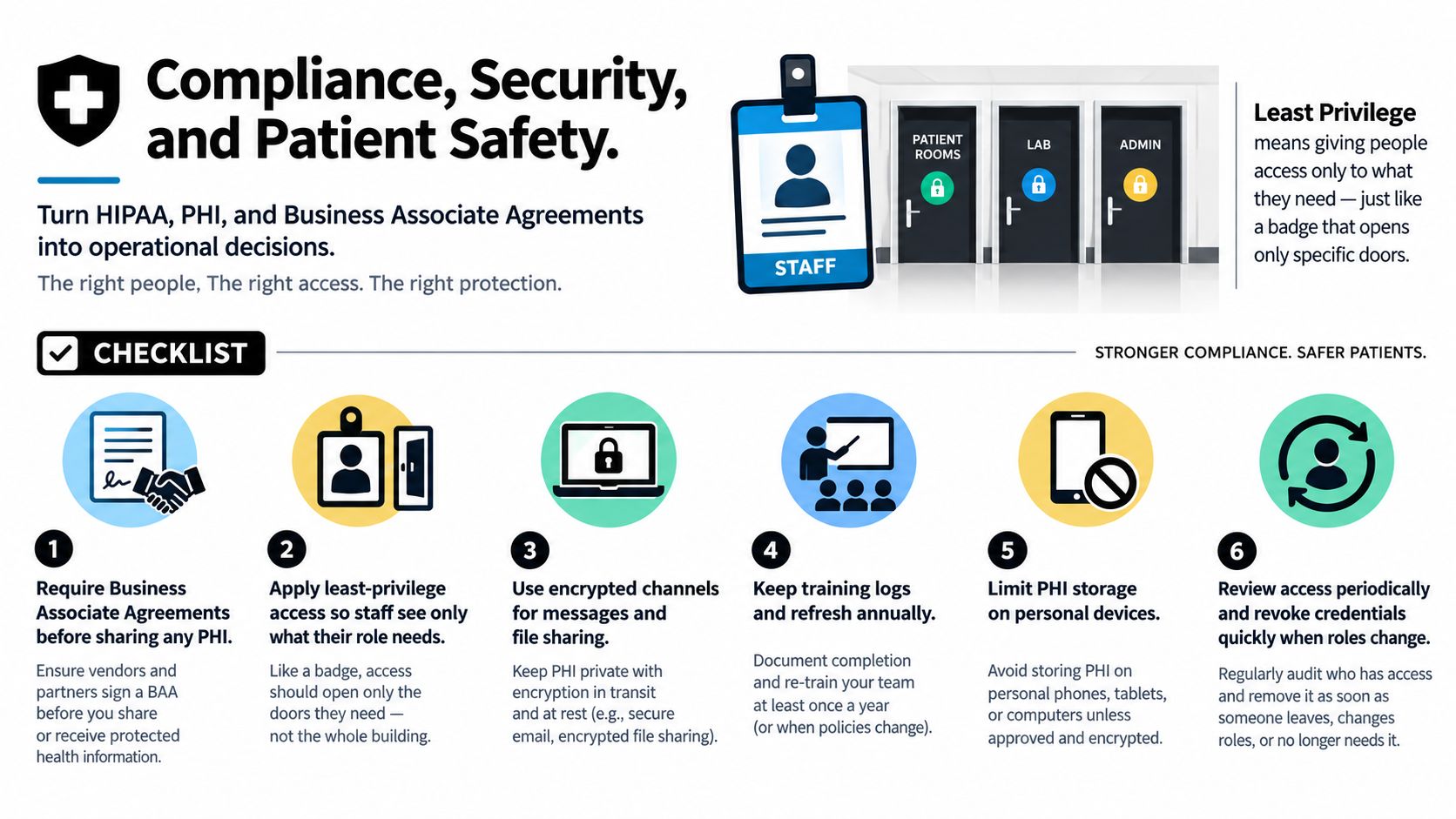
PHI, or protected health information, includes identifiable information connected with healthcare. Under HIPAA, a vendor handling PHI for a covered entity generally needs a business associate agreement, or BAA. The BAA assigns responsibilities, but signing one doesn't prove that the vendor uses safe systems or that the practice configured access correctly.
A useful analogy is a hospital badge system. A receptionist may enter the front desk and records area, while a clinician may enter treatment rooms. Neither person receives a badge for every door. Least-privilege access applies the same logic to an EHR. An assistant who schedules appointments may not need unrestricted access to behavioral-health notes, prescribing tools, or billing administration.
# Four controls to test before access
Identity verification should happen before a staff member discusses records, changes an appointment, or releases information. The script must define acceptable verification steps and what happens when the caller can't complete them.
Secure communication means approved channels for messaging, file exchange, and remote access. Personal devices and informal messaging apps create uncontrolled copies of PHI unless the practice has explicitly assessed and managed that risk.
Auditability requires logs that show access, edits, approvals, escalations, and account changes. A practice should be able to answer who opened a record, what was changed, and who reviewed a draft.
Incident response should identify reporting contacts, containment steps, investigation responsibilities, and patient or regulator notification duties where applicable. The plan must cover both human mistakes and AI-generated errors.
Healthcare AI adoption makes these controls more important. A 2025 survey of more than 600 professionals across healthcare-related sectors reported that 53% used AI-powered chatbots or virtual assistants. The same discussion highlights risks involving de-identification, consent, and data sharing, including additional requirements under China's PIPL for certain medical-data disclosures (healthcare AI security report (opens new window)).
| Control area | What to require | Why it matters |
|---|---|---|
| Contracting | Company-level BAA before PHI access | Establishes responsibilities before work begins |
| Access | Role-based, least-privilege EHR permissions | Limits exposure and reduces unauthorized actions |
| Identity | A documented patient-verification script | Prevents disclosure to the wrong person |
| Data transfer | Approved encrypted channels and country-specific review | Controls movement and storage of sensitive information |
| Oversight | Human review for clinical or uncertain outputs | Keeps decision authority with qualified staff |
| Audit | Access logs, training records, reviews, and incident reporting | Makes errors discoverable and correctable |
A practice can also review identity and access components through tools such as secure identity integrations for healthcare workflows (opens new window), while keeping the clinical system of record under the practice's governance.
# How LatHire Can Help
LatHire is an AI-powered hiring platform connecting United States and Canadian companies with pre-vetted Latin American professionals across technology, marketing, sales, and operations. For a practice evaluating nearshore support, that positioning addresses a practical problem: finding a person with the right administrative ability, schedule compatibility, and communication skills without building a cross-border recruitment process internally.
The platform uses AI assessments, skills evaluations, and human-led background checks to curate a candidate pool of more than 800,000 candidates, according to the provided company description. It can import an existing job description or generate one with AI, match a practice with candidates quickly, and provide support for HR, international payroll, benefits, and legal compliance.
# Where the platform fits
LatHire may suit a practice that wants a dedicated nearshore employee or contractor relationship but doesn't want to source, screen, and administer that person alone. Its profiles include validated skills, availability aligned with the client's time zone, and flexible engagement models. The platform also describes support for specialist roles and generalists, including customer support and administrative assistants.
It shouldn't be treated as a substitute for healthcare governance. A practice still needs to confirm HIPAA responsibilities, PHI access restrictions, EHR training, identity verification, escalation rules, and supervision. A hiring platform can improve talent acquisition, but it doesn't automatically make a candidate suitable for clinical-adjacent work.
For a more focused starting point, LatHire's guide to medical virtual assistants (opens new window) can help a practice define the role before comparing candidates. The strongest use case is a practice that wants one accountable, time-zone-aligned professional and has enough internal capacity to manage workflows, quality review, and compliance.
# Comparing Service Models and Staffing Structures
The right service model depends less on the label and more on who carries the management work. A freelance contractor may be inexpensive but leave the practice responsible for screening, backup coverage, training, and daily supervision. A managed agency may cost more while supplying quality assurance, replacement coverage, and a clearer escalation path.
The matrix below is a starting point, not a universal price list. Pricing varies by location, specialty, hours, employment structure, EHR requirements, and whether the assistant handles patient-facing work.
| Model | Typical cost | Supervision burden | Compliance maturity |
|---|---|---|---|
| Freelance contractor | Often the lowest quoted rate | High, because the practice manages the relationship directly | Varies widely and must be verified |
| Specialty agency | Mid-range to premium | Moderate, with recruiting or account support | Often stronger, but a company-level BAA must be confirmed |
| Offshore team | Lower labor cost for suitable back-office work | Moderate, especially during training and handoffs | Depends on vendor controls, location, and contract structure |
| Nearshore team | Mid-range, with time-zone and communication advantages | Moderate | Depends on the vendor's security program and data-transfer controls |
| Dedicated assistant | Higher continuity cost | Lower after onboarding | Clearer accountability when access and review are documented |
| Shared resource pool | Lower commitment and greater flexibility | Higher coordination burden | Requires careful access separation and queue ownership |
# Choose for continuity or flexibility
A primary-care practice with recurring scheduling, referral, and follow-up work often benefits from a dedicated assistant because the person learns provider preferences and local workflows. A smaller practice with intermittent inbox work may use a shared pool, provided the service-level expectations and access boundaries are explicit.
Behavioral-health practices need extra caution around sensitive notes, patient communication, and escalation. A low-cost generalist who can schedule appointments may still be a poor fit if the vendor can't restrict access or train the person on the practice's communication protocol.
A multi-specialty group may split the model. One dedicated resource can handle centralized scheduling, while specialty-specific staff manage prior authorization or documentation queues. This avoids forcing one generalist to interpret every specialty's workflow.
The cheapest hourly model can become the most expensive option when rework, delayed appointments, access reviews, and clinician supervision consume the expected savings.
The selection scorecard should include more than labor cost:
- Clinician time returned: How many hours does the assistant remove from documentation or coordination?
- Rework: How often must staff correct entries, messages, or scheduling mistakes?
- Denial rates: Does authorization and claim preparation improve, remain stable, or worsen?
- Appointment leakage: How many inquiries fail to become booked visits?
- Patient wait time: Do calls, referrals, and authorizations move faster?
- Coverage continuity: What happens during leave, turnover, or a sudden volume increase?
The best model is the one that produces dependable work with an acceptable oversight load. A vendor that cannot explain who reviews errors, who covers absences, and who signs the BAA hasn't completed the comparison.
# Pricing Ranges and the Real ROI Calculation
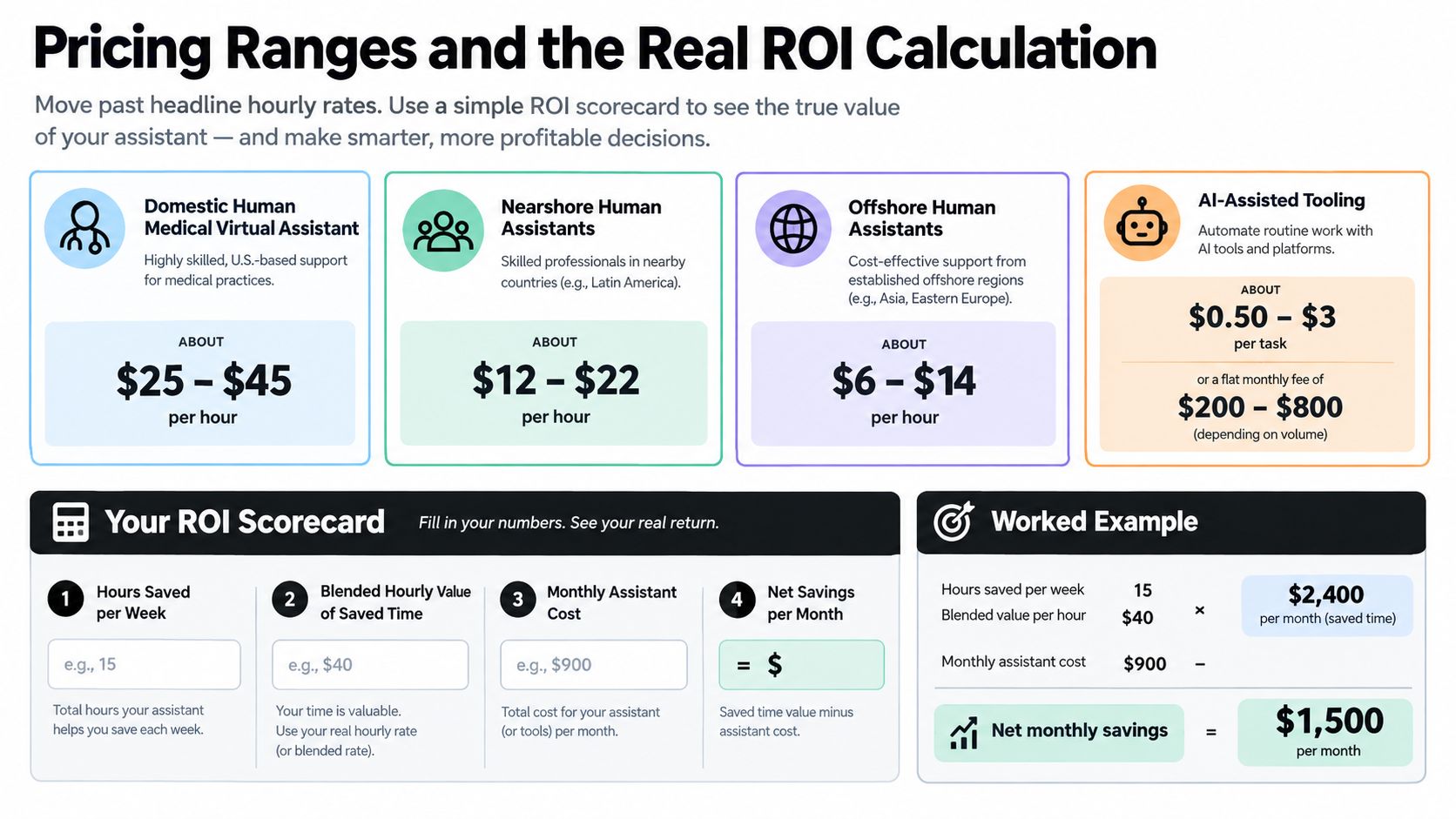
A quoted hourly rate answers only one question: what the supplier charges for labor or access. It doesn't show whether the practice gains capacity after onboarding, supervision, software, security controls, rework, and missed opportunities are included.
The supplied pricing infographic presents illustrative ranges for comparison: domestic human support at about $25 to $45 per hour, nearshore support at about $12 to $22 per hour, offshore support at about $6 to $14 per hour, and AI-assisted tooling at about $0.50 to $3 per task or a monthly fee around $200 to $800. Those figures should be treated as planning bands rather than universal quotes.
# Build the scorecard before selecting the vendor
Start with the hours the practice wants to recover. Then assign a blended value to those hours, based on the work that clinicians or staff can perform instead. Subtract the full monthly cost, not only the assistant's rate.
Include:
- Recruitment or setup time
- Training and supervision
- EHR and software costs
- Security and compliance administration
- Turnover and replacement coverage
- Rework from inaccurate entries
- Denied claims or delayed authorizations
- Lost appointments and patient wait time
- Clinician hours returned to care or revenue-producing work
The infographic's worked example uses 15 hours saved per week, valued at $40 per hour, producing $2,400 per month in saved time. After a $900 monthly assistant cost, the resulting net savings are about $1,500 per month. That example is a calculation model, not a guaranteed outcome.
A second scenario can produce the opposite result. Suppose a low-rate assistant enters the wrong appointment type, misses a payer attachment, and requires daily clinician correction. The practice may pay less for labor while losing time through rework and delayed care. The correct decision is to measure the error cost rather than celebrate the hourly rate.
# Use a controlled implementation sequence
Week one should define the queue. List each task, its inputs, its permitted action, its owner, and its escalation trigger. Separate administrative completion from clinical approval.
The next phase should test the vendor. Confirm the BAA, access controls, training records, EHR experience, location of work, device policy, incident process, backup coverage, and replacement terms.
The pilot should use baseline measures. Record current appointment response time, authorization turnaround, rework, unresolved calls, documentation backlog, and clinician time spent on the selected tasks.
Training should use real workflow examples without unnecessary PHI. The assistant should practice identity verification, message routing, documentation standards, and escalation. AI tools should be tested for omissions, unsupported conclusions, and inappropriate reassurance.
Ongoing review should remain scheduled. Compare the same measures after implementation, investigate exceptions, and change permissions when the role changes. Red-flag symptoms must always trigger clinician review or the practice's emergency pathway.
# Hiring and Implementation Checklist
A safe rollout can be small. The practice doesn't need to delegate every administrative task on the first day.
# Before the pilot
- Scope the queue: Select a narrow group such as reminders, referral status checks, or document preparation.
- Write decision rules: State what the assistant may complete, what requires approval, and what triggers immediate escalation.
- Vet the vendor: Request the BAA, security controls, training evidence, access model, audit process, location policy, and replacement plan.
- Set a baseline: Measure backlog, rework, response time, clinician effort, and unresolved patient requests.
# During the pilot
- Train with examples: Use approved scripts and de-identified or minimum-necessary information where possible.
- Review early work: A designated supervisor should sample outputs and correct patterns before the assistant receives broader access.
- Use a handoff script: Record the patient's request, relevant facts, action already taken, urgency, receiving owner, and required completion time.
- Escalate red flags: Chest pain, severe breathing difficulty, sudden neurological symptoms, uncontrolled bleeding, suicidal thoughts, severe allergic reactions, and other practice-defined emergencies must reach a licensed clinician or emergency pathway.
# At the review points
At the first review, the practice should decide whether the assistant follows the workflow safely. A later review should compare operational results with the baseline, including rework and clinician time. The final review should determine whether to scale, narrow, or end the pilot.
Liability shouldn't be left to informal assurances. The practice needs a documented owner for patient-care decisions, a vendor obligation to report incidents, and a process for stopping access quickly. A practice considering specialized recruiting support can also review healthcare technology recruiting considerations (opens new window) while keeping clinical governance with its own leadership.
# Practical Questions Practice Managers Actually Ask
Who is liable for a documentation error? The answer depends on the contract, workflow, supervision, and applicable law. The practice should define review ownership, require incident reporting, and prevent unreviewed drafts from becoming final clinical documentation.
Can an offshore assistant be safe under HIPAA? Location alone doesn't answer the question. The practice must verify the BAA, data-transfer controls, least-privilege access, secure devices, training, audit logs, and response process.
How long does implementation take? The answer varies with task complexity and EHR access. A narrow administrative pilot can begin before a broad clinical-adjacent workflow, but speed shouldn't replace testing.
How can a pilot end without disrupting patients? Stop new work first, keep the existing queue visible, transfer open items to named staff, revoke access, export required records, and notify patients only when the change affects their care or communication.
The next step is a written task map. For each proposed service, identify the action, the evidence required, the person who approves it, the escalation trigger, and the measure that will determine whether the arrangement stays.
A practice building secure healthcare workflows may also evaluate Socialite Providers (opens new window) for open-source authentication integrations, while retaining responsibility for access design, patient safety, and compliance review. Start by documenting one operational queue, then require every prospective vendor or staffing partner to answer the same questions about supervision, security, auditability, and clinical escalation before patient information is shared.